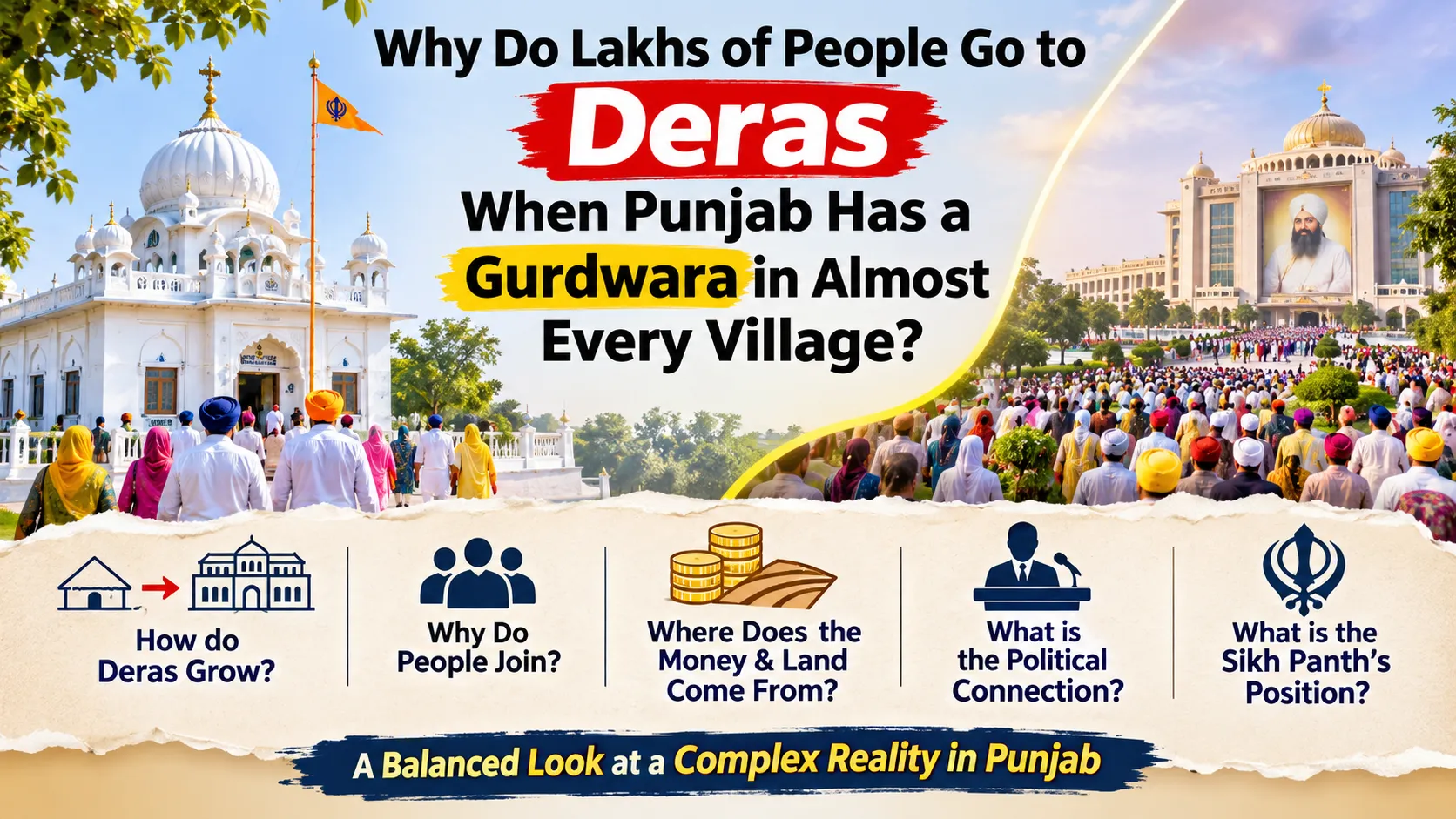
Almost every village in Punjab has a gurdwara, and for Sikhs, Sri Guru Granth Sahib Ji is the eternal Guru, the Shabad Guru. Yet lakhs of people still turn towards deras.
A small hut grows into a campus spread over thousands of acres within a few years. At election time, top political leaders line up to pay their respects. How does all this happen?
This article looks at how deras form, why people join them, where their money, land and political influence come from, and what the Sikh Panth’s position is.
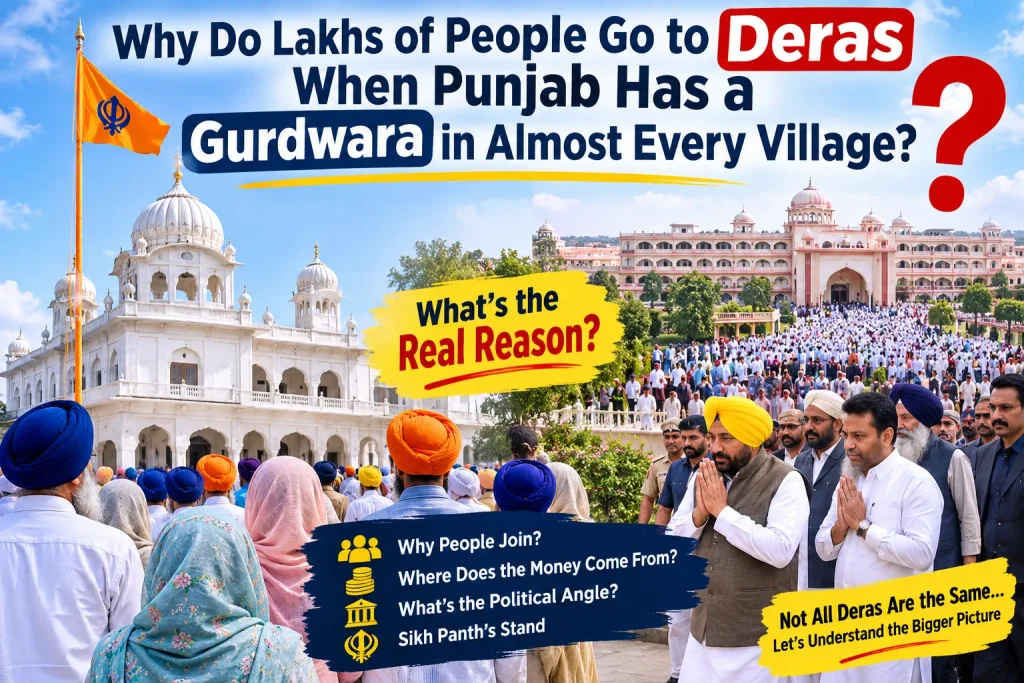
One point first: not all deras are the same. Some do real work in service and education, some belong to old spiritual traditions, and some have been at the centre of controversy. The aim here is not to condemn any one dera or person, but to understand how the phenomenon takes shape.
What Is a Dera?
The word dera simply means a resting place or camp. Traditionally, it was the dwelling of a sadhu, saint or fakir, where visitors could find food and rest.
Today, when people speak of a dera, they usually mean an organisation built around a living saint, baba or guru, with leadership often passing to a successor after him. This is the key difference. At a gurdwara, the centre is Guru Granth Sahib Ji. At a dera, the centre is often a living person.
How Deras Take Shape: Five Stages
Most deras follow a similar pattern.
- A charismatic leader. Someone draws attention through their speech, simplicity or spiritual discipline. Stories spread by word of mouth that this person is a “realised soul” whose blessings work.
- A simple message. Recite the Name, do seva, and your troubles will go away. There are no strict codes of conduct and no heavy conditions, which makes the path feel easy for ordinary people.
- Free facilities. Langar, shelter, hospitals, schools, de-addiction centres. Where public systems are weak, the dera fills the gap.
- Donations and land. Devotees’ offerings buy land and fund buildings, and sometimes farming and businesses grow alongside.
- Political influence. When lakhs of people are connected to one place, politicians begin to see a vote bank. The election-time visits are the result.
In Punjab, Radha Soami Beas, the Nirankari Mission, Dera Sacha Sauda and several others emerged at different times. Each has its own story, but the early pattern is often similar.
Why People Join Deras: Five Reasons
If Sikhs have their own Guru and their own gurdwaras, why do people look elsewhere?
1. The pain of caste discrimination. According to the 2011 Census, Scheduled Castes make up about 32% of Punjab’s population, among the highest shares in India. Guru Nanak Dev Ji rejected caste, but it has not disappeared from society. In some villages, there have been complaints of separate gurdwaras, separate cremation grounds and little share in management. This is not what Gurmat teaches. It is a failing of society. But people who are denied equality go where they find respect, and many deras offered that space. It became their greatest strength.
2. Poverty and lack of services. For a family that cannot afford treatment or school fees, free healthcare, free education and free meals are a lifeline. For them it is not a debate about religion. It is a need of daily life.
3. Personal suffering and emotional support. Illness, addiction, family conflict, unemployment. When a person is broken inside, they need someone to listen. When a baba says “don’t worry, everything will be fine,” those words feel like medicine.
4. Community and identity. A dera gives a shared identity: like-minded people, common gatherings, a sense of belonging. In an age of loneliness, that matters a great deal.
5. The pull of a living guru. Understanding scripture takes education and time. A living person who sits in front of you, answers questions, blesses you and listens is a deeply human attraction, and that is why many are drawn to a dehdhari (human) guru.
People do not go to deras only for religion. They go to find what they could not find elsewhere.
Money, Land and Politics
A small dera’s work is limited to langar, seva and satsang. But once the following reaches lakhs, money, land and politics tend to attach themselves.
Money and land. Devotees give donations out of faith. That money buys land, builds hospitals and schools, and sometimes runs farms and other businesses. None of this is illegal. The real question is transparency: where does the money go, who takes the decisions, and who keeps the accounts? Gurdwaras are run by committees, but in many deras the final decision rests with one person or one family.
Politics. It is no secret that leaders of every party visit deras around elections, and some deras have openly announced support for particular sides. The reason is simple: a signal from one dera can move thousands of votes, and when leaders come to bow their heads, the dera’s standing grows further.
When it turned into conflict. Punjab’s history offers two major examples:
- 13 April 1978, Vaisakhi, Amritsar. A clash between Sikhs protesting a Nirankari gathering and Nirankaris left 13 Sikhs dead. The incident shaped Punjab’s politics and the Panthic mood for years.
- 2007 and 2017, Dera Sacha Sauda. In 2007, outrage spread through the Sikh community over an attire worn by the dera head, and Sri Akal Takht Sahib took strong decisions. In 2017, after a court convicted the dera chief, violence broke out in Panchkula and Sirsa, and dozens lost their lives.
These events show that when faith, money and politics gather in one place, the matter stops being only about religion. It becomes a question of public peace.
It would still be wrong to say every dera is the same. Many contribute greatly to social service, education and healthcare and have never been part of any controversy. The real questions are who is taking the Guru’s place, and who is accountable.
The Sikh Perspective
According to Sikh tradition, Guru Gobind Singh Ji conferred the Guruship on Guru Granth Sahib in 1708. The Panthic tradition records the command as “Sabh Sikhan ko hukam hai, Guru Manyo Granth.” Note that this line comes from Sikh rehatnamas and Panthic tradition, not from Gurbani itself.
For this reason, Sri Akal Takht Sahib and the SGPC hold that Sikh Maryada has no place for a living human guru. For a Sikh, the Shabad is the Guru, and Guru Granth Sahib is the eternal Guru.
Is Opposing Deras Enough?
There is also a question Sikhs must ask themselves. People go to deras because they wanted equality, support, healthcare and a hearing. So is criticism alone enough?
If every person received equal respect in the village gurdwara, if gurdwaras became centres of schooling, libraries and counselling, and if every section of society had a share in management, people might never need to look elsewhere.
The real solution is not just to condemn deras. It is to make the Guru Ghar’s message of equality a reality in every village.
Conclusion
Deras are not built in a day. When society leaves a gap in equality, healing and support, someone will fill it. The question is who: the deras, or our own Guru Ghar?
So ask yourself:
- What role does your village gurdwara play today?
- Does everyone there get equal respect?
- Is there education for children, help for the needy, and support for the youth?
If yes, no one will need to go elsewhere. If not, then before blaming deras, we need to ask these questions of ourselves.
We’d like to hear from you: Which dera is in your village or city, why do people go there, and what service does your local gurdwara provide? Share your thoughts in the comments.
Waheguru Ji Ka Khalsa, Waheguru Ji Ki Fateh.