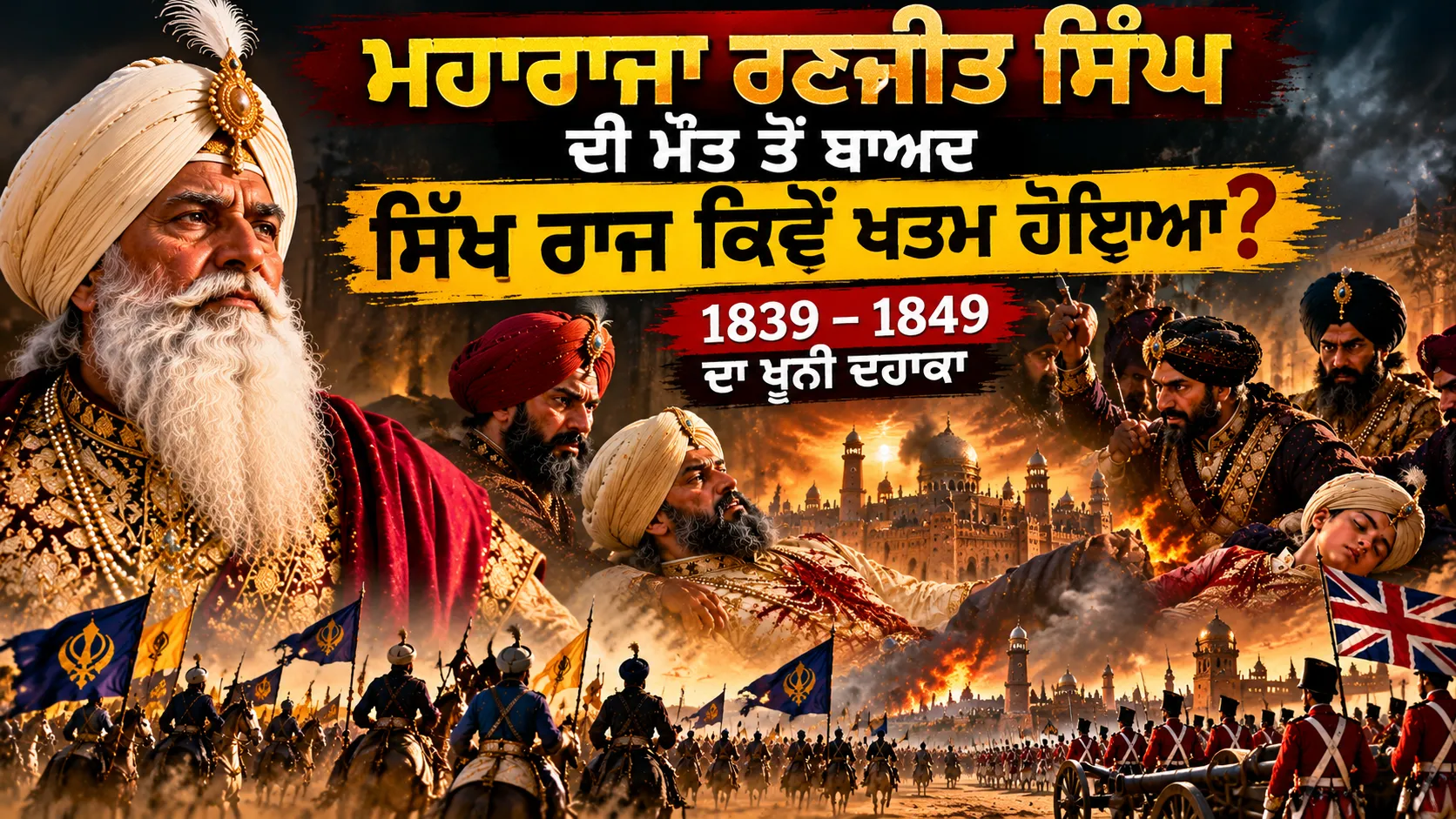
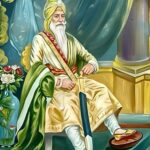
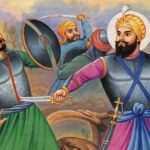
At the beginning of the nineteenth century, the Sikh Empire was one of the most powerful states in the Indian subcontinent. Under Maharaja Ranjit Singh, Punjab was politically united, its army was modernised, and Lahore became the centre of a kingdom that commanded respect from neighbouring powers—including the British East India Company.
Yet, only ten years after the Maharaja’s death, the independent Lahore kingdom had fallen. In 1849, the British annexed Punjab after two costly wars. How did a powerful empire reach this point so quickly? Its fall was not caused by one battle or one person alone. It resulted from a succession crisis, struggles within the royal court, changing relations between the army and government, and the expansionist ambitions of the British East India Company.
Maharaja Ranjit Singh and the Rise of the Sikh Empire
Maharaja Ranjit Singh was born in 1780 and rose to prominence when Punjab was divided among several Sikh misls, or political and military confederacies. He captured Lahore in 1799 and was proclaimed Maharaja in 1801. Over the following decades, he brought large parts of Punjab under his authority and expanded his kingdom towards Multan, Kashmir and Peshawar.
Ranjit Singh strengthened his army with modern artillery, disciplined infantry and training from European military officers. His administration included people from different religious and social backgrounds, reflecting the diverse character of the kingdom. He also dealt cautiously with the British. The Treaty of Amritsar in 1809 helped establish a boundary between the two powers.
His leadership held together a complex state for nearly four decades. But the kingdom relied heavily on his personal authority, and no succession system proved strong enough to maintain stability after his death.
1839: The Death That Changed Punjab’s Future
Maharaja Ranjit Singh died on 27 June 1839. His eldest surviving son, Kharak Singh, succeeded him, but his reign was troubled by court rivalries and political opposition. Kharak Singh died in 1840. His son Nau Nihal Singh was fatally injured on the same day while returning from his father’s funeral, after masonry collapsed near the Lahore Fort. The circumstances surrounding these events have been debated, but their political consequences were clear: the kingdom lost two potential centres of authority in quick succession.
Competing claimants and factions then struggled for power. Chand Kaur briefly claimed the regency, while Sher Singh eventually secured the throne in 1841. In 1843, Sher Singh and his son Pratap Singh were killed during a court conspiracy. Prime minister Dhian Singh Dogra was also killed in the turmoil.
Repeated changes in leadership weakened the government, damaged trust among officials and made it harder to coordinate the kingdom’s response to the growing British presence.
The Khalsa Army and the Crisis of Government
The Khalsa Army had been one of the greatest strengths of Ranjit Singh’s state. It was experienced, well-equipped for its time and capable of confronting powerful opponents. After the Maharaja’s death, however, the army became increasingly involved in political affairs as royal factions sought its support.
This did not mean that Sikh soldiers had lost their courage or military ability. During the wars that followed, they fought fiercely and inflicted serious losses on British forces. The deeper problem was that the relationship between the army, the royal court and the government had become unstable. Political divisions, command disputes and the financial burden of maintaining a large army made effective coordination more difficult.
British Expansion and Rising Tensions
While the Lahore court struggled with internal conflict, the British East India Company continued to expand its power across the subcontinent. British-controlled territories bordered the Sikh kingdom, and the Company increased its military presence near the Sutlej. Punjab remained one of the last major independent powers in northern India.
Ranjit Singh had managed a cautious relationship with the British, but after his death mistrust grew. The Company’s military preparations, its political ambitions and instability within the Lahore government all contributed to the deteriorating situation. The fall of the Sikh Empire therefore cannot be explained only as a result of internal weakness: British expansion and intervention were central to the outcome.
The First Anglo-Sikh War (1845–1846)
The First Anglo-Sikh War began in December 1845 after Khalsa forces crossed the Sutlej into British-controlled territory. The conflict included major battles at Mudki, Ferozeshah, Aliwal and Sobraon. Fighting was intense, and British forces suffered significant casualties. The Khalsa Army demonstrated that it remained a formidable opponent.
Ultimately, the British won the war. The Treaty of Lahore was signed in March 1846 and imposed heavy conditions on the defeated kingdom, including territorial concessions and financial payments. British influence over the Lahore government increased, and the kingdom’s independence was sharply restricted.
Maharaja Duleep Singh, Ranjit Singh’s young son, remained on the throne, but the state was increasingly supervised by British officials. Kashmir was transferred to Gulab Singh under a separate arrangement. The Lahore kingdom had survived, but it was no longer able to govern freely as it had under Ranjit Singh.
The Second Anglo-Sikh War (1848–1849)
In 1848, a revolt at Multan developed into a wider conflict against British authority. The uprising was associated with Diwan Mulraj and escalated after two British officers, Patrick Vans Agnew and William Anderson, were killed. The conflict spread as additional Sikh leaders and forces joined the resistance.
The Second Anglo-Sikh War included the Battle of Ramnagar, the costly Battle of Chillianwala and the decisive Battle of Gujrat on 21 February 1849. Sikh forces fought hard, and Chillianwala in particular demonstrated the dangers British troops faced. But the British ultimately won at Gujrat, and organised resistance collapsed.
The outcome reflected several connected factors: the political damage left by the first war, divisions among leaders, command and coordination problems, and the East India Company’s ability to sustain a major military campaign. It would be too simplistic to attribute the defeat to a single act of betrayal or to suggest that the Khalsa Army lacked courage.
Punjab Annexed in 1849
On 29 March 1849, the British East India Company formally annexed Punjab. Maharaja Duleep Singh was deposed, bringing the independent rule of the Lahore kingdom to an end. He was later taken away from Punjab and spent much of his life outside India. The Koh-i-Noor diamond, which had been part of the Lahore treasury, eventually passed into British possession.
Annexation transformed Punjab’s political future. The region came under direct Company administration, and the British removed the last major independent power in northwestern India. For the people of Punjab, it marked the end of a kingdom that had played a defining role in the region’s history.
Why Did the Sikh Empire Fall?
Several factors combined to bring about the empire’s collapse:
A succession crisis: Ranjit Singh’s death was followed by repeated changes in leadership and no stable transfer of power.
Political rivalries: Court conspiracies, assassinations and competition among factions weakened the central government.
A strained civil-military relationship: The army became deeply involved in politics, complicating decision-making and command.
British expansion: The East India Company sought to extend its territorial control and used the changing situation in Punjab to advance its influence.
The consequences of the first war: Territorial losses, financial pressure and British supervision left the Lahore kingdom in a vulnerable position.
Military and political divisions: Problems of coordination and leadership contributed to defeat in the two Anglo-Sikh Wars.
These factors reinforced one another. Internal instability made Punjab more vulnerable, while British military and political pressure turned that vulnerability into the loss of sovereignty.
The Legacy of Maharaja Ranjit Singh and the Sikh Empire
The end of the Sikh Empire did not erase its achievements. Ranjit Singh had unified much of Punjab, built a powerful army, developed an effective state and maintained a kingdom that British leaders had to treat as a serious regional power. The resistance shown by Sikh soldiers in the Anglo-Sikh Wars remains an important part of the period’s history.
The decade after 1839 also offers a lesson about the importance of stable institutions and peaceful succession. A state’s survival depends not only on military strength, but also on political unity, trusted leadership and the ability to respond to external challenges.
Conclusion
The Sikh Empire did not fall overnight. After Maharaja Ranjit Singh died in 1839, succession struggles weakened the Lahore government. The First Anglo-Sikh War of 1845–1846 reduced the kingdom’s independence, and the Second Anglo-Sikh War of 1848–1849 ended it. On 29 March 1849, Punjab was annexed by the British East India Company.
The story is both one of remarkable achievement and of a kingdom undermined by internal divisions while facing an expanding colonial power. Understanding both sides of this history gives us a clearer picture of how Punjab lost its independence—and why the legacy of the Sikh Empire continues to matter.
What do you think was the most important reason behind the fall of the Sikh Empire: internal divisions, the succession crisis, or British expansion? Share your thoughts in the comments.
Explore more Sikh history, inspiring personalities and historical stories on SikhHeros.com.
References and Further Reading
Priya Atwal, Royals and Rebels: The Rise and Fall of the Sikh Empire, Oxford University Press, 2020.
Khushwant Singh, A History of the Sikhs, Volume 2: 1839–2004, Oxford University Press.
J. S. Grewal, The Sikhs of the Punjab, Cambridge University Press, 1990.
This article provides an accessible historical overview. Some details about court conspiracies, individual motives and responsibility for particular military decisions remain contested among historians.