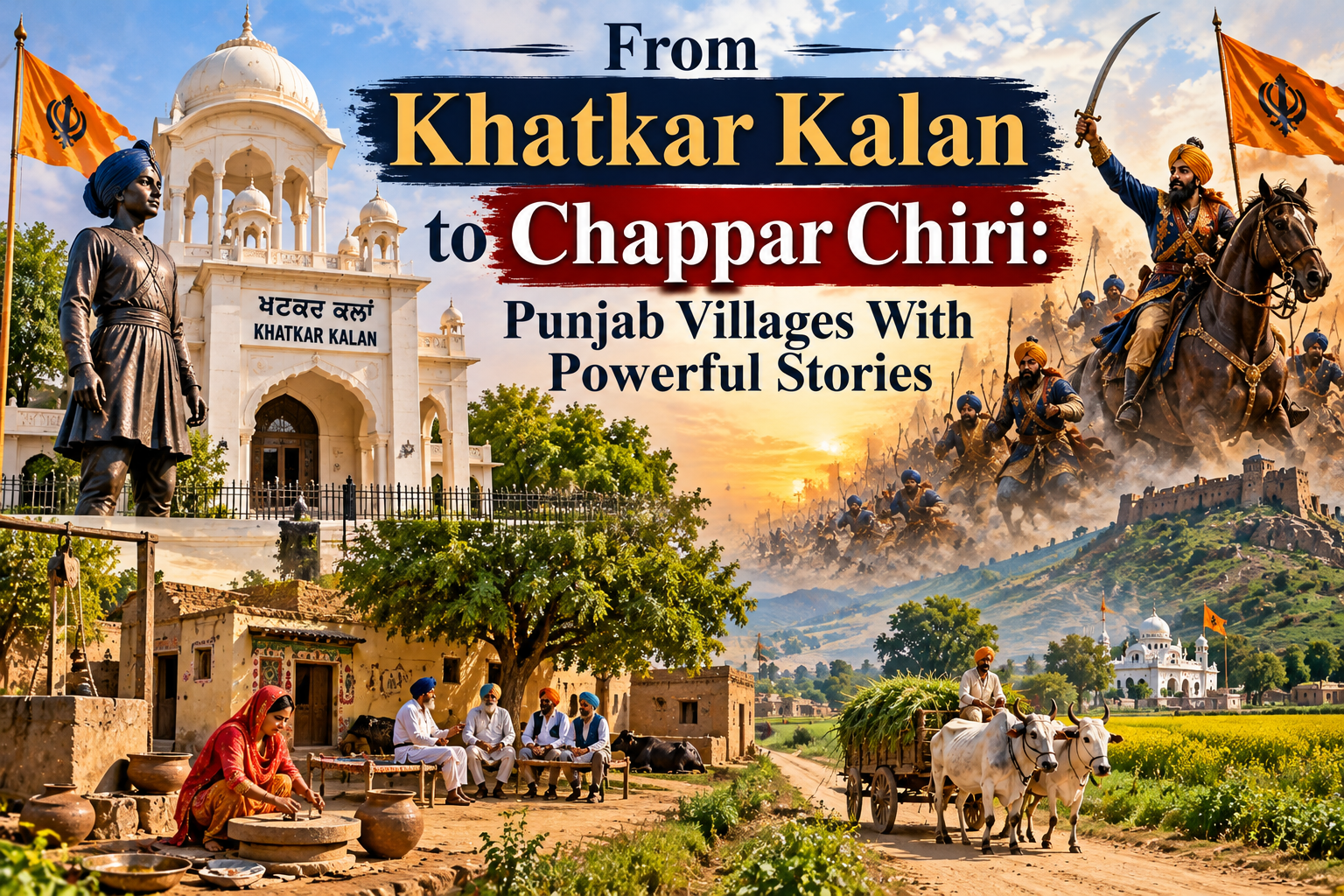
Punjab’s villages hold stories that reach far beyond their fields and streets. Some are remembered for revolutionaries, others for battles, faith, literature or resistance. Khatkar Kalan and Chappar Chiri are two striking examples: one is closely linked with the family legacy of Bhagat Singh, while the other recalls a decisive battle led by Banda Singh Bahadur in 1710.
Khatkar Kalan: the ancestral village of Bhagat Singh
Khatkar Kalan, in today’s Shaheed Bhagat Singh Nagar district of Punjab, is associated with the ancestral family home of revolutionary Bhagat Singh. Although Bhagat Singh was born in Banga village in present-day Pakistan in 1907, Khatkar Kalan remains an important place of remembrance for his family’s roots and his role in India’s independence movement.
The village is associated with a museum and memorial dedicated to Shaheed-e-Azam Bhagat Singh. Visitors come to reflect on his ideas, his opposition to colonial rule and the sacrifices of young revolutionaries.
What makes Khatkar Kalan’s story powerful?
Bhagat Singh’s legacy is not simply a tale of personal bravery. He wrote about political freedom, social justice, communal harmony and the responsibilities of citizens. Remembering him in the village linked to his family brings national history into a local setting.
Chappar Chiri: where Banda Singh Bahadur changed history
Chappar Chiri, near Mohali in Punjab, is remembered as the site of the Battle of Chappar Chiri in May 1710. Sikh forces led by Banda Singh Bahadur defeated the army of Wazir Khan, the Mughal governor of Sirhind. Wazir Khan was killed in the battle, and the victory opened the way for Sikh forces to take Sirhind.
This campaign followed the persecution and execution of the younger Sahibzadas of Guru Gobind Singh at Sirhind, events deeply remembered in Sikh history. Banda Singh Bahadur’s victories also became associated with challenges to oppressive landholding arrangements and efforts to give cultivators greater rights, although historians debate the precise reach and durability of his reforms.
The Fateh Burj memorial
Today, the Fateh Burj memorial at Chappar Chiri commemorates Banda Singh Bahadur and the Sikh victory. The monument gives visitors a place to reflect on the battle and its significance in Sikh history. It is a memorial landscape rather than a surviving battlefield frozen exactly as it appeared in 1710.
Two villages, two kinds of courage
Khatkar Kalan represents the memory of anti-colonial revolutionary thought in the twentieth century. Chappar Chiri recalls military resistance and political change in the early eighteenth century. Their histories are different, but both show how places outside major cities can become powerful symbols of collective memory.
Other Punjab villages with stories worth exploring
Saragarhi and the memory of Sikh soldiers
The 1897 Battle of Saragarhi took place in the Tirah region, now in Pakistan, rather than in an Indian Punjab village. Its memory nevertheless lives across Punjabi communities through commemorations of the 21 soldiers of the 36th Sikhs who defended the post. This distinction matters when discussing the geography of Punjabi heritage.
Jallianwala Bagh and nearby communities
Jallianwala Bagh is in Amritsar city, not a village. The 1919 massacre, however, affected families from across Punjab, including rural communities. Village oral histories can help connect the well-known site with the wider social impact of colonial repression.
Villages connected to the Ghadar movement
Many participants in the early twentieth-century Ghadar movement came from Punjabi villages. Their journeys between Punjab and overseas communities reveal how migration helped shape ideas of political freedom. Individual village connections should be verified through local records and memorial archives.
How to explore these places respectfully
- Visit local museums and memorials and read the information presented on site.
- Check opening hours and access arrangements before travelling.
- Ask residents about local traditions without assuming every story is documented history.
- Distinguish ancestral homes, birthplaces, battle sites and modern memorials.
- Support the preservation of photographs, family records and oral histories.
Why preserving village history matters
Local heritage can be lost when buildings disappear, families migrate or stories are no longer told. Careful documentation allows younger generations to learn about the people and events associated with their communities. It also helps correct popular misconceptions, such as confusing a historical figure’s birthplace with an ancestral village.
Frequently asked questions
Was Bhagat Singh born in Khatkar Kalan?
No. Bhagat Singh was born in Banga, in present-day Pakistan. Khatkar Kalan is his ancestral village in Indian Punjab.
Where is Chappar Chiri?
Chappar Chiri is near Mohali (Sahibzada Ajit Singh Nagar), Punjab.
What happened at Chappar Chiri in 1710?
Banda Singh Bahadur’s Sikh forces defeated the army of Wazir Khan of Sirhind in a decisive battle.
What is Fateh Burj?
Fateh Burj is a memorial tower at Chappar Chiri commemorating Banda Singh Bahadur’s victory.
Conclusion
From the ancestral home of Bhagat Singh’s family at Khatkar Kalan to the battlefield remembered at Chappar Chiri, Punjab’s villages connect national history with local landscapes. Visiting and documenting these places helps keep their stories alive—while honoring the difference between historical evidence, public memory and legend.