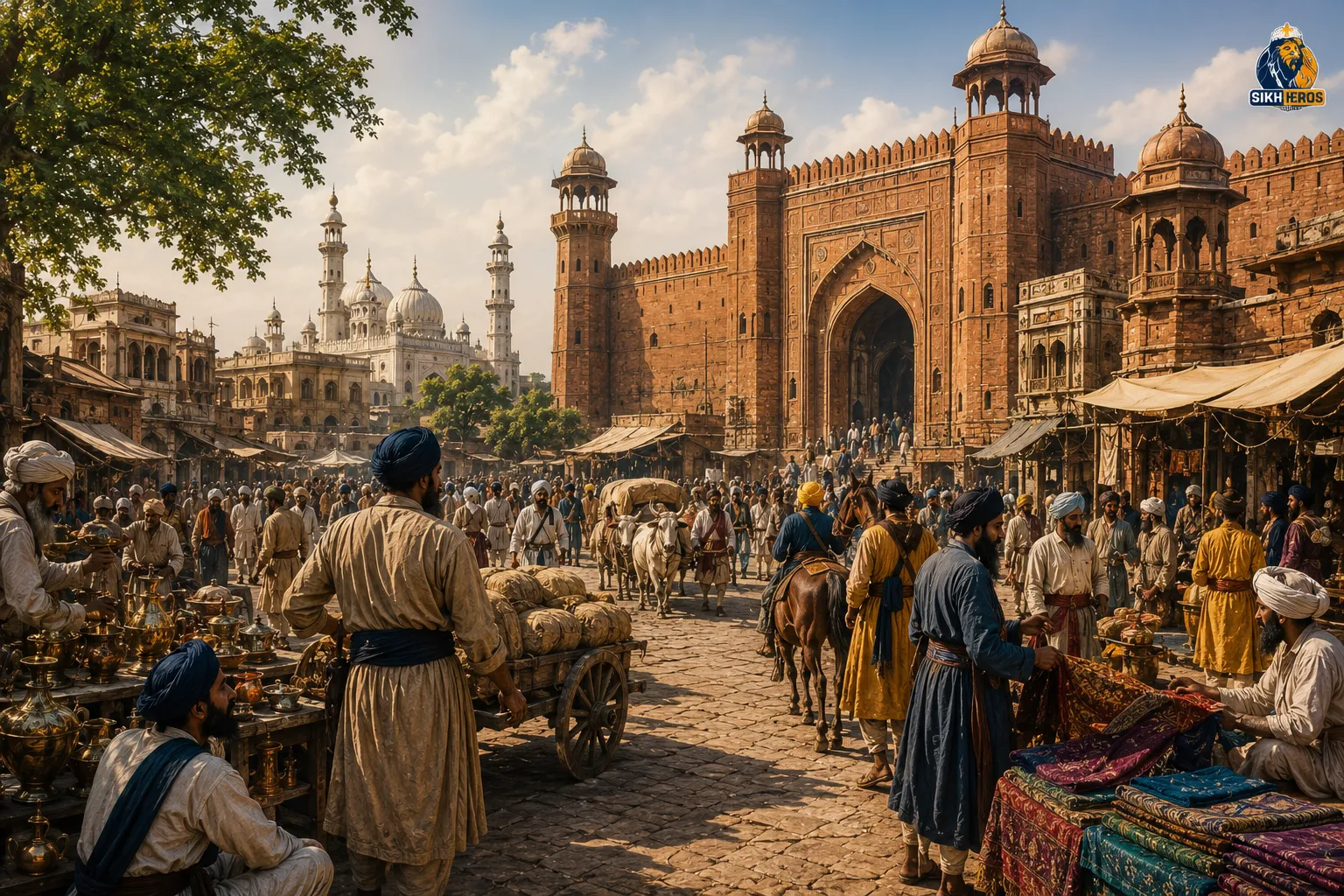
When people think of Lahore today, they picture the magnificent Lahore Fort, the Badshahi Mosque, bustling bazaars, and centuries of history. Yet few realize that by the late eighteenth century, Lahore had become a city devastated by repeated invasions, political instability, and economic decline.
Within just a few decades, however, the city experienced one of the most remarkable recoveries in South Asian history. Under the leadership of Maharaja Ranjit Singh, Lahore was transformed into the capital of the Sikh Empire and emerged as one of the most prosperous commercial and political centers of northern India.
Was this transformation simply the achievement of a powerful ruler, or was it the result of visionary administration, economic reforms, military security, and religious inclusiveness?
Let’s explore the fascinating story.
Lahore Before Maharaja Ranjit Singh
For centuries, Lahore had served as one of the greatest cities of the Mughal Empire. Its strategic location made it an important center for trade between Central Asia and the Indian subcontinent.
However, following the death of Aurangzeb in 1707, Mughal authority weakened rapidly.
The decline of central power exposed Punjab to repeated invasions.
Some of the most destructive invasions included:
- Nadir Shah (1739)
- Ahmad Shah Durrani’s multiple invasions
- Continuous Afghan raids throughout the eighteenth century
Each invasion brought:
- Looting
- Political instability
- Population displacement
- Economic collapse
- Declining trade
Merchants abandoned Lahore because security no longer existed.
The once-thriving city gradually lost much of its former prosperity.
The Weak Rule of the Bhangi Misl
By the end of the eighteenth century, Lahore was controlled by leaders of the Bhangi Misl.
Although the Bhangi Misl had once controlled large parts of Punjab, internal rivalries weakened its administration.
Instead of providing stable governance, competing factions struggled for power.
Law and order deteriorated.
Merchants feared robbery.
Trade slowed dramatically.
Many historians describe Lahore during this period as a city desperately in need of strong leadership.
The Rise of Maharaja Ranjit Singh
In 1799, a young Sikh leader from the Sukerchakia Misl marched toward Lahore.
His name was Maharaja Ranjit Singh.
Despite losing the sight of one eye during childhood due to smallpox, Ranjit Singh possessed remarkable military skill, diplomatic ability, and political vision.
Unlike many contemporary rulers, he understood that lasting power depended not only on military victories but also on stable governance and public confidence.
According to historical accounts, influential citizens of Lahore—including merchants, local elites, and administrators—invited him to take control of the city in hopes of restoring stability.
On 7 July 1799, Maharaja Ranjit Singh entered Lahore with relatively little resistance, marking the beginning of a new era.