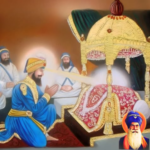
Mata Gujri Ji stands as one of the most revered and inspiring figures in Sikh history. Her life was not merely one of personal devotion, but a powerful embodiment of courage, patience, spiritual strength, and unwavering faith. She holds the rare distinction of being the first Sikh woman martyr, and her legacy is inseparably woven into the very survival and spirit of Sikhism.
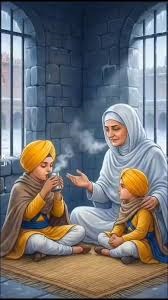
She was the wife of a martyr, mother of a martyr, grandmother of four martyr Sahibzadas, and herself a martyr who attained shaheedi while reciting Gurbani. Through her teachings and upbringing, she shaped the moral and spiritual backbone of Sikh history.
Early Life and Marriage
Mata Gujri Ji was born at Kartarpur (near present-day Kapurthala, Punjab) to Bhai Lal Chand Subulikka and Bibi Bishan Kaur, a deeply spiritual and noble couple originally from Lakhnaur (Ambala district, Haryana).
During a visit to Kartarpur with the marriage party of his elder brother Suraj Mal, Tyag Mal—later known as Guru Tegh Bahadur—captured the hearts of Gujri Ji’s parents with his humility, spiritual aura, and dignified appearance. The betrothal took place when Gujri Ji was young, and the marriage was solemnized on 4 February 1633, following the custom of child marriage prevalent at the time.
Historical Sikh texts describe the union beautifully:
“Like bridegroom, like bride. Gujri is by destiny made worthy of Tegh Bahadur in every way.”
— Gurbilas Chhevin Patshahi
From the very beginning, Mata Gujri Ji earned admiration for her grace, humility, gentle speech, devotion, and inner strength.
Life of Simplicity, Seva, and Spiritual Discipline
After marriage, Mata Gujri Ji lived with the Guru’s family in Amritsar and later Kartarpur. In 1635, she witnessed her husband’s exceptional bravery during Mughal attacks on Guru Hargobind Ji. Pleased by his valor, Guru Hargobind Ji bestowed upon Tyag Mal the title Tegh Bahadur—“Bearer of the Sword.”
Following the passing of Guru Hargobind Ji in 1644, Mata Gujri Ji, Guru Tegh Bahadur Ji, and Mata Nanaki Ji moved to Bakala (near Amritsar). Here, for over two decades, the family lived a secluded and spiritually disciplined life. Guru Tegh Bahadur Ji meditated deeply in a bhaura (underground cell), while Mata Gujri Ji carried out her duties as a devoted wife and daughter-in-law, immersed in seva and simran.
Becoming the Mother of the Tenth Guru
In 1664, Guru Tegh Bahadur Ji was formally installed as the Ninth Sikh Guru. In 1665, he founded Chakk Nanaki, later known as Anandpur Sahib, naming it after his mother.
Soon after, the Guru undertook an extensive journey to eastern India. While traveling to Bengal and Assam, he left his family in Patna under the care of Kirpal Chand. It was here, on 22 December 1666, that Mata Gujri Ji gave birth to a son Guru Gobind Singh (then named Gobind Rai).
The birth came 33 years after her marriage, making it a moment of immense joy and gratitude. Mata Gujri Ji distributed alms, served the poor, and dedicated herself fully to raising the child who would later transform Sikh history.
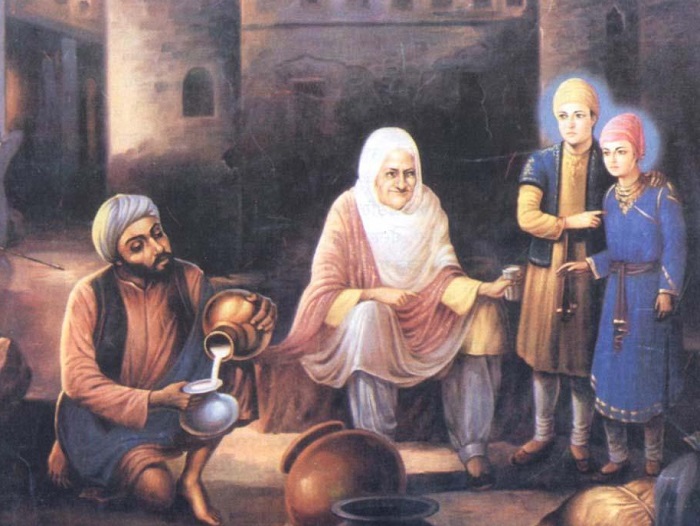
Raising a Warrior-Saint
After reuniting with her husband briefly in Patna, Mata Gujri Ji later returned with her family to Anandpur Sahib. In 1675, Guru Tegh Bahadur Ji was arrested and later executed in Delhi for defending the religious freedom of Kashmiri Pandits.
At this moment of unimaginable grief, Mata Gujri Ji displayed extraordinary fortitude. She accepted the Guru’s martyrdom as Divine Will and assumed responsibility for managing the affairs of Anandpur Sahib, as Guru Gobind Singh Ji was still a child.
She oversaw his education, spiritual grounding, martial training, and moral development—preparing him for his destiny as the leader of the Khalsa. Her letters to Masands reveal a woman who was compassionate yet uncompromising toward corruption and injustice.
The Creation of the Khalsa and a Mother’s Resolve
In 1699, when Guru Gobind Singh Ji initiated the Khalsa and demanded five heads, some Sikhs approached Mata Gujri Ji in fear. Her response reflected absolute faith in her son’s mission:
“My son cannot kill his Sikhs.”
She supported the abolition of the corrupt Masand system and never interfered when justice demanded firm action.
Separation at Sirsa and Ultimate Sacrifice
In December 1705, following a prolonged siege by Mughal and hill forces, Anandpur Sahib had to be evacuated. During the chaotic crossing of the flooded Sirsa rivulet, Mata Gujri Ji was separated from Guru Gobind Singh Ji along with her younger grandsons—Zorawar Singh (9) and Fateh Singh (7).
Betrayed by their servant Gangu, they were handed over to Mughal authorities and imprisoned in Thanda Burj (the Cold Tower) at Sirhind—an open structure without walls or warmth during the freezing winter.
Despite her advanced age and harsh conditions, Mata Gujri Ji remained steadfast. She narrated stories of past Sikh martyrs to her grandsons and urged them to never abandon their faith, even at the cost of their lives.
Martyrdom of the Sahibzadas and Mata Gujri Ji
The children were repeatedly threatened, tempted, and ordered to convert to Islam. They refused. On 26 December 1705, they were ordered to be bricked alive. When the wall collapsed, they were beheaded the following day.
Upon hearing of their martyrdom, Mata Gujri Ji thanked Waheguru for granting her grandsons the strength to uphold Dharma. Meditating on Gurbani, she attained martyrdom the same day, thus becoming the first Sikh woman shaheed.
Cremation and Sacred Memorials
Seth Todar Mal, a compassionate and wealthy devotee, purchased land at an enormous price and cremated the bodies with full honor.
Today, the sacred sites stand as eternal reminders:
- Gurdwara Mata Gujri (Thanda Burj) – where she spent her final days
- Gurdwara Joti Sarup – the cremation site
- Fatehgarh Sahib – a major Sikh pilgrimage center
Every year in late December, thousands gather here to commemorate the supreme sacrifices.
Legacy That Sustains Sikhism
Mata Gujri Ji’s life is a beacon for generations. She exemplified Guru Nanak Dev Ji’s words:
“Why call her inferior from whom kings are born?”
Through her faith, resilience, and upbringing of the Sahibzadas, she preserved the spirit of Sikh martyrdom and ensured the survival of Sikh values against tyranny.
As Sikhs, we owe our existence to Mata Gujri Ji.
Her life was not just lived it was offered.