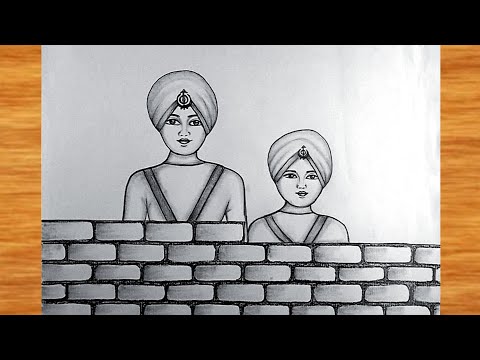
The Sahibzadas were brought out of the court. Outside, executioners were already preparing the bloody wall—the living grave meant to silence two innocent lives forever. A crowd had gathered, unable to believe what they were about to witness. Faces were frozen in shock; eyes overflowed with tears.
One question echoed silently in every heart: What crime could these children possibly have committed?
Yet, on the faces of the Sahibzadas, there was no fear, no sorrow, no hesitation. They stood calm and resolute—like seasoned warriors marching into battle, or like grooms walking willingly toward a sacred union with death.
They told the soldiers firmly:
“Do not touch us. We will walk ourselves into the foundations.”
As written by Allah Yar Khan Yogi (Shaheedan-e-Wafa):
“Do not hold our hands. Today, we will walk alive into the wall— with joy.”
The Sahibzadas stepped into the foundations. The Qazi spoke one last time:
“There is still time. Accept Islam, and your lives will be spared.”
The reply was unwavering:
“Build the wall quickly. This wall will mark the end of Mughal rule and raise the palace of Sikh faith.”
Holding each other’s hands, they raised the eternal Sikh call:
Jo Bole So Nihal — Sat Sri Akal!
They closed their eyes and began reciting Japji Sahib. The executioners started laying bricks.
As poet Charan Singh Safri wrote:
“A bloody wall is rising, Two roses stand between its foundations. Upon innocent souls, The palace of Sikh faith is being built.”
It was as if the sky darkened in mourning. The heavens wept. The earth absorbed the tears. The entire universe cried out in anguish.
Brick by brick, the wall rose—up to their chests, then their necks. Their moon-like faces slowly disappeared, as if eclipsed. The beloved sons of Guru Gobind Singh Ji, the cherished grandsons of Mata Gujri Ji, vanished behind stone and cruelty.
As breathing became impossible, their breaths slowed… and the Sahibzadas lost consciousness.
On the orders of Wazir Khan and the Qazi, the wall was demolished—only to confirm their martyrdom.
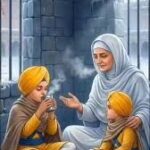
At that very moment, Mata Gujri Ji, imprisoned in the cold tower, embraced eternal meditation and left her physical body, reuniting spiritually with her grandsons.
Allah Yar Khan Yogi writes:
“We gave our lives so others may live. We lifted the foundation of Sikh faith upon our heads. We planted the seed of the Khalsa’s sovereignty. A time will come when crowns and thrones will belong to the Panth— and the tyrant’s trace will vanish from the world.”
Diwan Todar Mal, a jeweler by profession, could not bear the thought of the martyrs’ bodies being dishonored. Overwhelmed with devotion, he approached Wazir Khan seeking permission to cremate the bodies with respect.
The greedy Wazir Khan demanded an unthinkable price:
“Cover the land you need with gold coins—and only then may you take it.”
Without hesitation, Todar Mal laid gold coins across the land and performed the cremation of Mata Gujri Ji and the Sahibzadas with full honor. History remembers him not for his wealth—but for his selfless devotion.
Ages That Shamed Tyranny
Sahibzada Baba Zorawar Singh Ji: 7 years, 11 months
Sahibzada Baba Fateh Singh Ji: 5 years, 10 months
At an age when children seek comfort, these souls displayed courage greater than empires. Their sacrifice created a unique and unmatched chapter in world history.
They are remembered not for a single day—but throughout the entire month of December, during Shaheedi Saptah, as symbols of faith, resilience, and righteousness.
The Fall of the Mughal Empire
When Guru Gobind Singh Ji received news of the martyrdom, he uprooted a shrub with the tip of his arrow and declared:
“The roots of Mughal rule have been torn out. Its end is near.”
History proved him right.
Baba Banda Singh Bahadur later destroyed Sirhind, brick by brick, ending Wazir Khan’s tyranny and raising the flag of Sikh sovereignty—marking the true beginning of the Mughal Empire’s downfall.
Final Reflection
The martyrdom of the Sahibzadas was not just an act of sacrifice—it was a spiritual earthquake that shook tyranny at its core. Their silence spoke louder than armies. Their faith outlived empires.