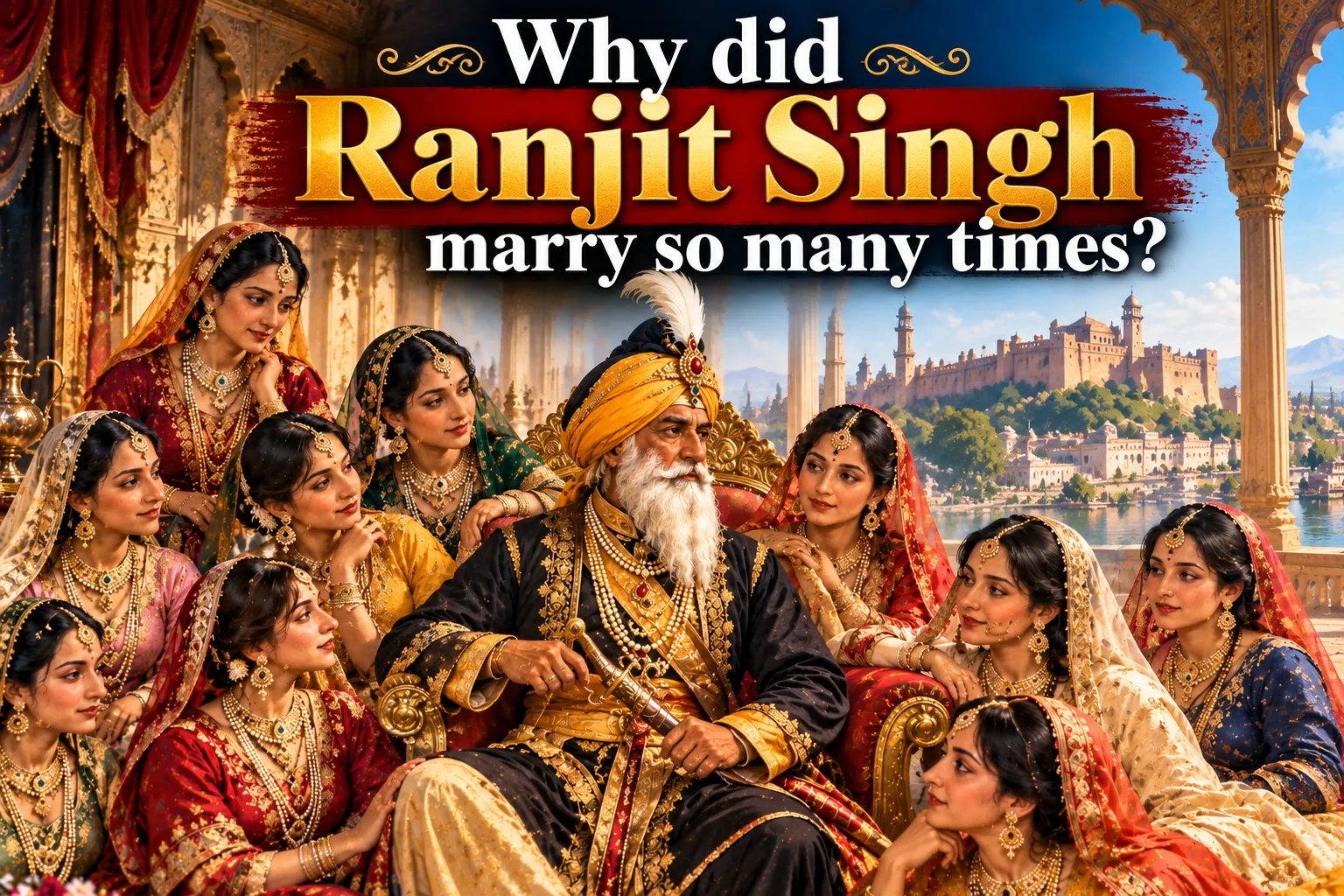
Why did Maharaja Ranjit Singh marry so many times? The answer goes beyond his private life. In eighteenth- and nineteenth-century Punjab, royal marriages could create alliances, reconcile rival families, establish political legitimacy and influence succession. Ranjit Singh’s marriages also reflected the customs and inequalities of the royal court.
How many wives did Maharaja Ranjit Singh have?
There is no universally agreed number. Historical accounts distinguish between formal marriages, unions conducted through chadar andazi (a form of marriage ceremony), and women recorded as consorts. Some sources list sixteen or twenty wives, while historian Priya Atwal discusses a larger official list of thirty. Claims of still higher totals circulate, but the differing definitions make a single exact number misleading.
Political alliances between Sikh misls
Before the Sikh Empire emerged, Punjab contained several Sikh misls, or confederacies, whose chiefs competed and cooperated. Marriage could strengthen relations between these ruling houses. Ranjit Singh’s early marriages connected the Sukerchakia Misl with other powerful families, providing allies as he expanded his influence.
Mehtab Kaur: an alliance with the Kanhaiya Misl
Mehtab Kaur, daughter of the influential Sada Kaur, was Ranjit Singh’s first wife. Their marriage helped link the Sukerchakia and Kanhaiya families despite a history of conflict. Sada Kaur later became one of Ranjit Singh’s most important political and military allies, including during his rise to power in Lahore.
The marriage was not necessarily a happy personal union. Accounts describe tension rooted in earlier fighting between the families. This illustrates how royal marriages could serve political aims even when personal relationships were difficult.
Datar Kaur: a connection with the Nakai Misl
Ranjit Singh also married Raj Kaur of the Nakai family, widely known as Datar Kaur or Mai Nakain. This alliance strengthened ties with another important Sikh house. Datar Kaur became a prominent figure in the royal family and was the mother of Kharak Singh, who succeeded Ranjit Singh in 1839.
Jind Kaur and the question of succession
Jind Kaur was among Ranjit Singh’s later wives and the mother of Duleep Singh, born in 1838. After the Maharaja’s death, competing claims and court factions created a succession crisis. Duleep Singh eventually became Maharaja, and Jind Kaur played an important political role during his minority. Her story reminds us that royal women were participants in the history of the Sikh court, not merely names on a list.
Were all the marriages political?
No. Although several early marriages had clear diplomatic value, it would be inaccurate to assign a single motive to every relationship. Personal affection, court custom, status and changing circumstances also mattered. Historians must rely on sometimes conflicting chronicles and records, which rarely reveal the private intentions of everyone involved.
What was chadar andazi?
Some of Ranjit Singh’s unions are described as chadar andazi or chadar pauna, a ceremony associated with placing a shawl over the woman as a sign of marriage. Historical sources do not always classify these unions in the same way as other marriages. This is one reason modern counts of the Maharaja’s wives vary.
How did the marriages affect the Sikh Empire?
Marital alliances helped create relationships among powerful families during the rise of the Lahore Darbar. But royal marriages also brought complex questions about inheritance, court influence and the standing of different heirs. After 1839, the struggle for succession showed how unstable dynastic politics could become.
Watch: Why Did Ranjit Singh Marry So Many Times?
Explore this fascinating question in our SikhHeros video:
Watch the full video on YouTube.
Frequently asked questions
Who was Maharaja Ranjit Singh’s first wife?
Mehtab Kaur, daughter of Sada Kaur of the Kanhaiya Misl, was his first wife.
Who was the mother of Kharak Singh?
Datar Kaur, also known as Raj Kaur Nakai or Mai Nakain.
Who was the mother of Maharaja Duleep Singh?
Jind Kaur was the mother of Duleep Singh, the last Maharaja of the Sikh Empire.
Why do historians give different numbers of wives?
Sources use different definitions for formal marriages, chadar andazi unions and consorts, and surviving records are not always consistent.
Conclusion
Maharaja Ranjit Singh’s many marriages cannot be explained by one reason alone. His early unions helped build political alliances among Sikh ruling families; others reflected personal relationships and royal customs. Looking closely at Mehtab Kaur, Datar Kaur and Jind Kaur also reveals the significant roles women played in shaping the history of the Sikh Empire.
Further reading
- Priya Atwal, Royals and Rebels: The Rise and Fall of the Sikh Empire (Oxford University Press, 2020).
- History of the Sikh Misals — historical discussion of matrimonial alliances.
- Of Music and the Maharaja: Gender, Affect, and Power in Ranjit Singh’s Lahore — academic research on royal court relationships.