How could a few cannons lost in a river help a young Sikh leader gain control of Lahore? The story connects Afghan ruler Shah Zaman, the flooded River Jhelum and the rise of Maharaja Ranjit Singh in 1799. Yet the cannons did not capture the city by themselves. They became part of a much larger story of diplomacy, alliances and military action.
Lahore before Maharaja Ranjit Singh
At the end of the eighteenth century, Punjab was divided among Sikh misls and other regional powers. Lahore was controlled by leaders of the Bhangi Misl, while Afghan ruler Shah Zaman sought to reassert Durrani influence. Ranjit Singh, the young chief of the Sukerchakia Misl, was emerging as an ambitious and capable leader.
Why did Shah Zaman leave his cannons behind?
Shah Zaman advanced into Punjab and occupied Lahore in the late 1790s. Political turmoil in Afghanistan forced him to retreat. During his withdrawal, flooding at the River Jhelum caused several heavy artillery pieces to become stranded or lost in the water. Cannons were expensive, difficult to transport and valuable for warfare, making their recovery an urgent concern.
How Ranjit Singh recovered the cannons
Historical accounts describe Ranjit Singh arranging the recovery of artillery from the Jhelum and sending some guns back to Shah Zaman. A commonly repeated version says that eight of twelve cannons were recovered and returned, although accounts differ about the exact number.
For the young chief, the incident offered more than an opportunity to assist a rival. It opened a diplomatic channel with a powerful Afghan monarch at a moment when control of Lahore was uncertain.
Did Shah Zaman give Lahore to Ranjit Singh in exchange?
According to a well-known historical tradition, Shah Zaman offered Ranjit Singh recognition or authority over Lahore in return for recovering the artillery. Some historians report that he received a robe of honour or a formal grant.
However, historians disagree about the timing and strength of this claim. Evidence for a direct exchange is not equally clear in all contemporary accounts. Even if an Afghan endorsement was offered, it did not physically transfer the city: Lahore still had its own rulers, defenders and political interests.
How Ranjit Singh actually took Lahore in 1799
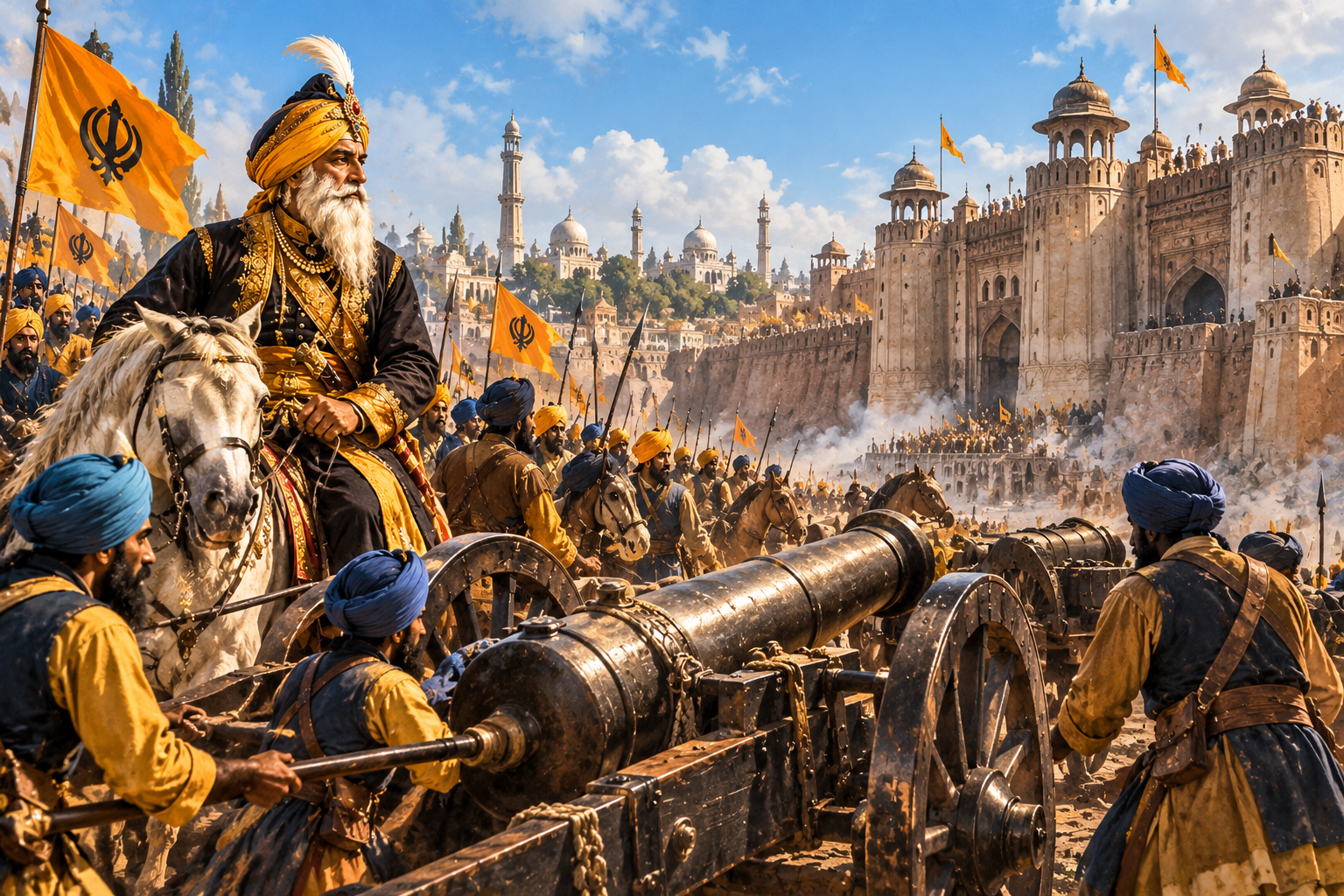
Ranjit Singh built alliances and gained support from people dissatisfied with the city’s existing administration. His mother-in-law and influential ally, Sada Kaur of the Kanhaiya Misl, played an important part in strengthening his position. In July 1799, his forces advanced on Lahore, then held by Bhangi chiefs. Ranjit Singh secured control of the city, with 7 July 1799 commonly given as the date of the conquest.
The achievement depended on the political weakness of his opponents, local support and military force—not simply on a promise connected to the lost cannons.
Why the cannons mattered
The Jhelum artillery episode shows Ranjit Singh’s ability to turn a military problem into a diplomatic opportunity. Whether or not Shah Zaman formally granted Lahore in exchange, the episode helped establish the young chief’s reputation for resourcefulness and negotiation.
Control of Lahore transformed his political future. He made it the centre of his expanding state and, in 1801, assumed the title of Maharaja. Lahore went on to become the capital of the Sikh Empire.
Were these the famous Zamzama cannons?
The guns associated with Shah Zaman’s retreat should not automatically be confused with the celebrated Zamzama cannon, also known as the Bhangi Toap. Zamzama has a separate history and came into Ranjit Singh’s possession later, in 1802, according to the Lahore Museum.
Watch the full story: How Did the Cannons Lead to Lahore?
Watch our video for a visual account of this fascinating episode in Sikh and Punjabi history.
Watch How Did the Cannons Lead to Lahore? on YouTube.
Frequently asked questions
When did Maharaja Ranjit Singh capture Lahore?
He took control of Lahore in July 1799, before assuming the title of Maharaja in 1801.
Which river was connected to the lost Afghan cannons?
The River Jhelum, where flooding disrupted Shah Zaman’s retreating artillery.
Did Ranjit Singh receive Lahore just by returning cannons?
No. Some historical accounts describe an offer of Afghan recognition in exchange for recovering the guns, but Ranjit Singh still secured Lahore through alliances, local political support and military action.
Who helped Ranjit Singh capture Lahore?
Sada Kaur, his mother-in-law and an influential leader of the Kanhaiya Misl, was a major ally.
Conclusion
The cannons in the Jhelum did not roll into Lahore and win it. Instead, their recovery became a memorable example of Ranjit Singh’s diplomatic skill at a turning point in Punjab’s history. His actual conquest of Lahore in 1799 laid the foundation for the Sikh Empire.
Further reading
- Lion of Punjab: Maharaja Ranjit Singh — SikhHeros
- How Ranjit Singh captured Lahore — Dawn
- History of the Zamzama cannon — Lahore Museum