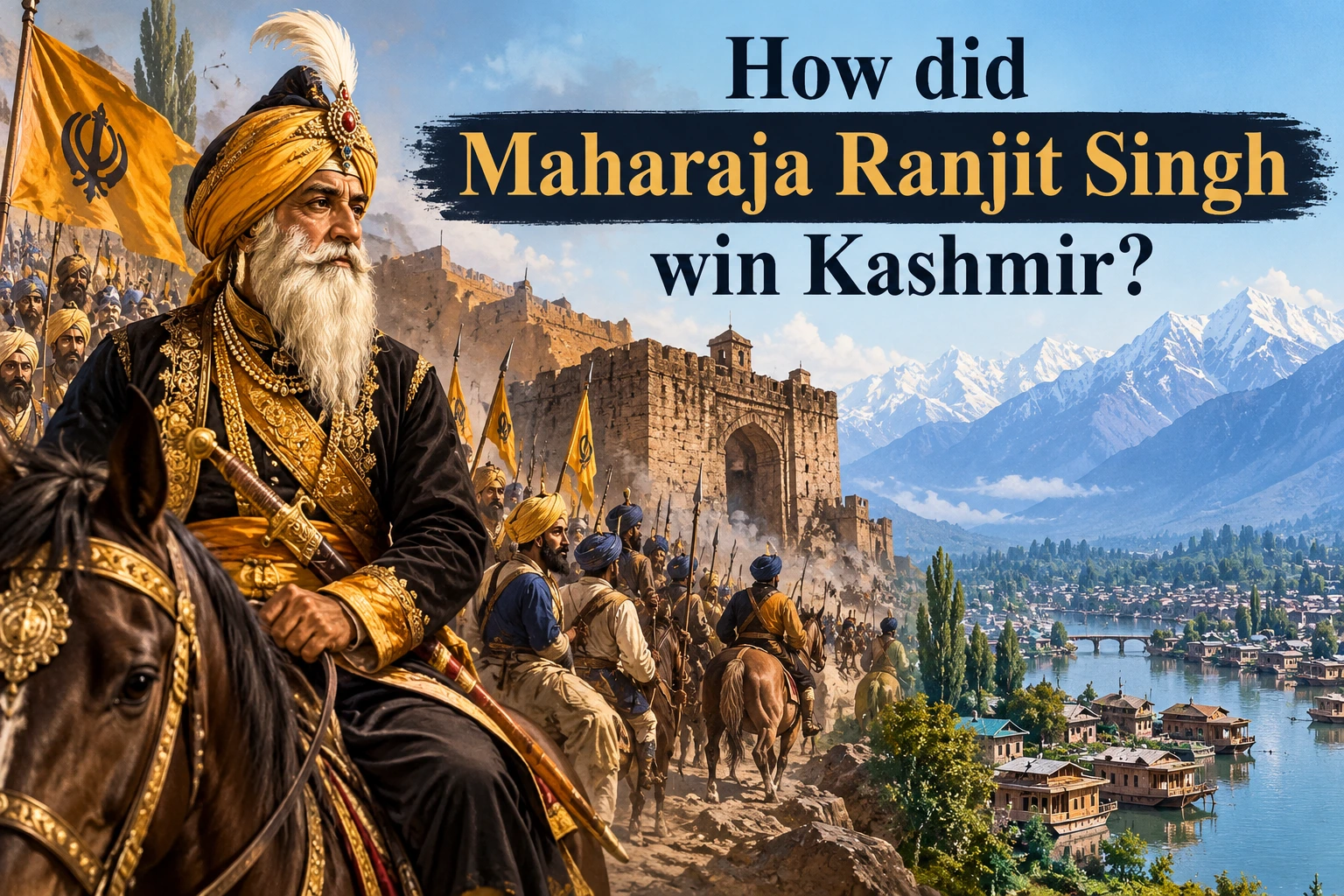
In 1819, Maharaja Ranjit Singh’s Sikh Empire conquered Kashmir, ending centuries of Afghan rule over the valley. The victory was not the result of one dramatic charge by the Maharaja himself: it was a carefully organized campaign carried out by experienced commanders, supported by the growing military strength of the Lahore Darbar.
Kashmir occupied an important position north of Punjab, with valuable trade routes connecting the valley to surrounding mountain regions. Afghan governors had ruled Kashmir under the Durrani Empire, and reports of harsh taxation and political instability contributed to dissatisfaction with that rule. For Ranjit Singh, securing Kashmir also meant expanding and protecting the northern frontier of his kingdom.
Earlier attempts to enter Kashmir
The 1819 conquest followed earlier Sikh involvement in Kashmir. In 1814, an expedition led by Ranjit Singh failed, in part because of difficult mountain terrain, severe weather and logistical problems. That setback demonstrated that success would require better timing, supplies and coordination.
The Sikh campaign of 1819
In 1819, the Lahore Darbar organized a major expedition under commanders including Misr Diwan Chand, with Prince Kharak Singh also associated with the campaign. Sikh forces advanced toward the Kashmir Valley through challenging passes and mountain routes. Other officers, including Hari Singh Nalwa, are frequently mentioned in accounts of the campaign, although sources differ about individual battlefield roles.
The army’s preparations were important. Moving troops, weapons, provisions and artillery through mountainous country was difficult, and the campaign depended on coordinated advances rather than cavalry strength alone.
The Battle of Shopian
The decisive confrontation took place near Shopian in July 1819, where Sikh forces faced the Afghan administration’s army, commanded by Jabbar Khan. The Sikh army defeated the Afghan forces, opening the way toward Srinagar. Jabbar Khan withdrew, and Afghan control over the valley collapsed.
After the victory, Kashmir came under the authority of the Sikh Empire, with officials appointed to administer the newly conquered territory. The conquest is commonly dated to July 1819.
Did Maharaja Ranjit Singh personally fight at Shopian?
Although the conquest is rightly associated with Maharaja Ranjit Singh’s leadership, he did not personally command the battlefield action at Shopian. He directed the wider strategy from his kingdom while his generals led the campaign. This distinction matters when understanding how the Sikh Empire operated as a military and administrative power.
What changed after the conquest?
The victory extended Sikh authority into the Kashmir Valley and marked a major expansion of Ranjit Singh’s state. It ended Afghan political control there, but it did not mean that every difficulty facing Kashmir’s inhabitants disappeared. The Sikh period brought a new administration and its own taxation and governance policies, which historians continue to examine critically.
Watch: How Did Maharaja Ranjit Singh Win Kashmir?
For a visual retelling of the 1819 campaign, watch our video below:
In which year did Maharaja Ranjit Singh conquer Kashmir?
The Sikh Empire conquered the Kashmir Valley in 1819.
Who led the Sikh army in Kashmir?
Misr Diwan Chand was a principal commander of the 1819 expedition. Prince Kharak Singh and other Sikh officers also played roles in the campaign.
Which battle decided the conquest?
The Battle of Shopian in July 1819 was the decisive engagement against Afghan forces.
Who ruled Kashmir before the Sikh conquest?
Kashmir was governed by Afghan rulers associated with the Durrani Empire before the Sikh victory.
Conclusion
Maharaja Ranjit Singh’s conquest of Kashmir was achieved through military preparation, strategic leadership and the victory of his commanders at Shopian. The campaign of 1819 became one of the defining territorial achievements of the Sikh Empire and remains an important chapter in the history of Punjab and Kashmir.